

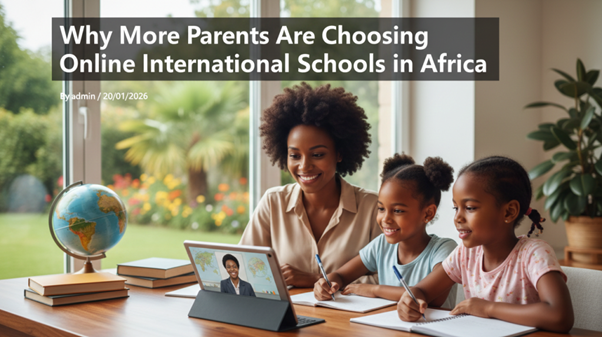
For a long time, the word “homeschooling” felt like a foreign concept in many African households. We grew up with the traditional image of education: heavy backpacks, long commutes, and rigid rows of desks. But a revolution is quietly unfolding across the continent.
Education is no longer confined to four brick walls. As high-speed internet becomes more accessible from Nairobi to Kampala, Dodoma to Kigali. African parents are seeking something more than just the regular schooling – they are looking for future-proofing. Several core factors are driving this transition toward online homeschooling as a more flexible, world-class educational experience.
- The African Context: A New Era of Choice
In many of our cities, the traditional top-tier education often comes with a costly price: hours spent in gridlock traffic, rising tuition costs for physical infrastructure and other overheads, and sometimes, physical classrooms in which the teaching methods are static.
African parents are deeply invested in their children’s legacy, and they are realizing that a local physical boundary shouldn’t limit a child’s intellectual boundary. By choosing an online International school, parents are transcending geographical boundaries. Whether you are in a bustling capital or a quiet suburb, you now have direct access to the Cambridge Curriculum, the same gold standard used by the elite schools, right from your living room.
- The Value Paradox: Elite Quality at an Affordable Rate
One of the most compelling reasons for the shift toward online learning is the correction of the Value Paradox. Traditionally, a Cambridge-standard education in Africa required a massive financial investment, largely to fund the school’s physical infrastructure – swimming pools, sports complexes, and sprawling campuses.
Online international schools remove these bricks-and-mortar overheads without compromising the academic core. Parents are finding that they can access the same gold-standard curriculum and the same expert educators at a significantly more accessible fee. This shift allows families to invest in what truly matters: a world-class education that doesn’t sacrifice the household’s financial stability. You are no longer paying for the building; you are paying for the brilliance of the instruction.
- Reclaiming the Time Tax
In most African urban hubs, the commute is a silent thief. Children are spending two to four hours a day in school buses or cars. By the time they arrive at school, they are exhausted; by the time they get home, they have no energy for homework or play.
More importantly, this exhaustion creates a relational deficit. When children spend their best energy fighting traffic and their remaining energy on late-night assignments, they lose the opportunity to meaningfully interact with their family. Online homeschooling eliminates this time tax, transforming hours once wasted in gridlock into moments for family bonding, shared meals, and mentorship. A child who is well-rested and present at home is not just a better student – they are a more connected member of the family.
- Safety and Mental Well-being
Traditional school environments can be harsh. Bullying, negative peer pressure, and the crowd mentality of large classrooms often stifle a child’s confidence. Online learning provides a controlled, safe environment where the focus remains on academic and personal growth. Parents are no longer outsourcing their child’s character development to a crowded playground; they are reclaiming the right to protect their child’s mental space and emotional health.
- Global Standards Without the Bricks-and-Mortar Cost
Many parents want the Cambridge Curriculum, but the cost of physical international schools is becoming unsustainable. Often, tuition fees are inflated to cover swimming pools, manicured lawns, and the massive electricity bills of a physical campus. Online international schools strip away these infrastructure costs. This allows parents to transcend geographical boundaries and pay for what actually matters: world-class teachers and a globally recognized curriculum.
- Personalization Over Factory Learning
Traditional schools in Africa often suffer from overcrowded classrooms where a teacher must move at the pace of the average student. If a child is gifted, they are bored. If they struggle with a concept, they are left behind. Online homeschooling moves away from this factory-style learning. It is inherently personalized, allowing a student to truly master a concept before moving on, ensuring there are no holes in their educational foundation.
- Digital Fluency as a Default
We are preparing children for a 21st-century workforce that is increasingly remote and tech-driven. A child who learns to manage their own schedule, communicate via digital platforms, and use professional tech tools is already years ahead of a peer using only a physical textbook. By choosing this path, parents are ensuring their children are creators and innovators of technology, not just passive consumers.
- The Power of Project-Based Learning
A major reason parents are making the switch is the move away from rote memorization. Through Project-Based Learning, students engage in deep, meaningful work. Instead of just memorizing facts about the environment, a student might be tasked with designing a sustainable waste-management plan for their own neighborhood. This approach makes learning stick because it is tied to real-world application, building the confidence and innovation needed to lead Africa into the next century.
ABOUT THE AUTHOR

Derick Gachogu is a seasoned educator specializing in English and literature across major international curricula, including Cambridge and IB. As the co-founder and Chief Strategy Officer (CSO) of Novastra International School, Derick blends classroom expertise with educational leadership to drive academic excellence and strategic growth.